Nobody has to talk a sales team into a competition. The hard part is finding one that isn’t another pipeline review, that gets people talking who usually only meet on a forecast call, and that wraps up before anyone reaches for their phone.
Whether you call it team building or employee engagement for your sales team, here are twenty ideas, grouped by how much time you’ve got. Each one comes with what you do, how long it takes and how many people it suits. Most are free. There’s also a section on running team building at your sales kickoff (SKO), since that’s where a lot of these end up.
What makes a good team building activity for a sales team?
A few things we’ve learned from running team events since 2004.
- Make it competitive, but not personal. Salespeople like a scoreboard. They don’t need another one that ranks individuals the way the quota does. Team scores keep the energy and lose the edge.
- Mix people up. New business and account management, inside sales and field, SDRs and closers. The best activities put people together who’d never normally share a table.
- Keep a link to the day job, loosely. Pitching, persuading, listening and thinking on your feet all transfer. Role play that feels like an appraisal doesn’t.
- Respect the calendar. Every hour a rep spends away from selling has a cost. Short and focused beats long and worthy, especially in a meeting.
Quick games for sales meetings (5 to 15 minutes)
These are the out-of-the-box sales meeting ideas. Drop one in at the start of a Monday meeting or halfway through a long one.
1. The elevator pitch challenge
Everyone draws a random object, from a stapler to a houseplant, and gets 30 seconds to prep and 60 seconds to pitch it to the room. The room votes for the pitch they’d most like to buy from. You need a bag of odd items or a list of random products.
Time: 10 minutes. Group size: 4 to 20.
2. Objection tennis
Pair people up. One throws a real objection they’ve heard this month (“we’ve already got a supplier”, “send me some information”) and the other has five seconds to return it. Swap after five rallies. Quick, funny, and the best answers get shared with the team.
Time: 10 minutes. Group size: any, in pairs.
3. Win of the week
Each person gets one minute to tell the story of a deal, a call or a small moment that went well, and what they did to make it happen. It’s the simplest idea on this list and one of the most useful, since people pick up each other’s tactics.
Time: 5 to 15 minutes. Group size: up to 15.
4. Group juggle
Stand in a circle and throw a soft ball across the circle, saying the name of the person you’re throwing to. Once the pattern is going, add a second ball, then a third. It’s a classic energizer, and it shows very quickly who listens and who doesn’t.
Time: 5 to 10 minutes. Group size: 8 to 20 per circle.
5. Two truths and a lie, customer edition
Each person shares three facts about a customer they look after, one of which is made up. The team guesses the lie. It gets people talking about accounts they’d never normally hear about, and it works just as well on a video call.
Time: 10 to 15 minutes. Group size: 5 to 15.
For more quick openers, our guide to icebreakers has plenty that suit a meeting room or a video call.
Sales training games (15 to 45 minutes)
These have more structure. They’re good for a training session or the second half of a team meeting.
6. Sell it back
Split into pairs. The buyer picks a product from a list of everyday things, and the seller has to find out why they’d want it before pitching a single feature. The buyer only buys if the seller asks at least three good questions first. It’s discovery practice that doesn’t feel like practice.
Time: 20 minutes. Group size: any, in pairs.
7. Role reversal
Your most experienced rep plays the buyer and a newer colleague runs the call. Then swap. Everyone else scores the call on a simple card, like “did they find the real problem?” You’ll need three or four realistic buyer briefs written in advance.
Time: 30 minutes. Group size: 6 to 20.
8. The Red/Black game
A classic negotiation game. Four teams each choose red or black over ten rounds, and the scores depend on what the other teams choose. Teams that trust each other do well together. Teams that try to win at everyone else’s expense usually end up worse off. The debrief is where the learning is.
Time: 45 minutes. Group size: 8 to 24, in four teams.
9. The product knowledge quiz
Write 20 questions on your own products, pricing and competitors, and run it as a team quiz on a free tool like Mentimeter, Slido or Google Forms. Throw in a few general knowledge rounds so the new hires have a chance.
Time: 20 to 30 minutes. Group size: any, in teams of 4 to 6.
10. The questions-only call
In pairs, one person plays a prospect and the other can only speak in questions for three minutes. No statements, no pitching. It’s harder than it sounds and it shows people how often they talk when they should be listening.
Time: 15 minutes. Group size: any, in pairs.
Bigger team building days for sales teams (half a day or more)
When you’ve got an offsite, a sales retreat or a quarter to celebrate, these give people time to get to know each other properly.
11. A city scavenger hunt
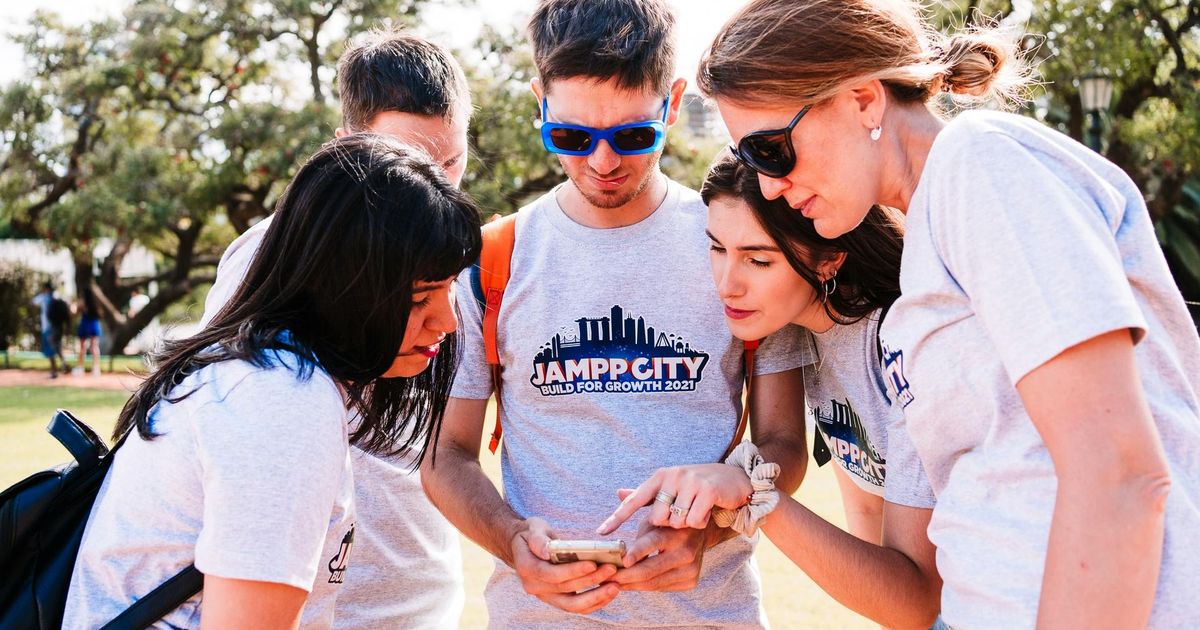
Teams race between landmarks, solving clues and taking photo challenges, with a leaderboard that updates as they go. You can plan your own with printed clues and a group chat, or book a GPS version.
Time: 2 hours. Group size: 10 to 100 plus.
12. A cook-off or cocktail class
Most cities have cooking schools that run team challenges, where each team cooks a dish and a judge picks the winner. Salespeople like a clear result, and everyone gets dinner.
Time: 2 to 3 hours. Group size: 8 to 40.
13. An escape room
Teams of four to six solve puzzles against the clock. It rewards the people who notice things rather than the people who talk loudest, which is a nice change for some teams. Book a local venue or run a virtual one for spread-out teams.
Time: 60 to 90 minutes. Group size: teams of 4 to 6.
14. A volunteering afternoon
Pack boxes at a food bank, clear a community garden, or run mock interviews at a local school. It’s a good fit for a team that’s had a hard quarter and doesn’t want to compete for once.
Time: half a day. Group size: 6 to 50.
15. Field day
Bowling, mini golf, cornhole or a softball game. It’s low stakes, easy to organize and suits a mixed group. Pick something where skill matters less than enthusiasm, so the same three people don’t win everything.
Time: 2 hours. Group size: 8 to 60.
Run it for you: hosted activities from Wildgoose
If you’d rather someone else did the planning, scoring and hosting, these are the ones we’d suggest for a sales team. Everything runs on phones through our Mobile Adventures app, with a live host and teams of 4 to 6.
16. The Pitch
The Pitch is the most sales-flavored thing we run. Teams build a product idea through creative business, photo and video challenges, then the top teams pitch it to the room and everyone votes for the winner through the app.
Time: 90 minutes. Group size: 8 plus. In person, virtual or hybrid.
17. The Winter Games
In The Winter Games, teams race through winter sports themed trivia, photo and video challenges to take gold on a live leaderboard. It’s a good fit for a January kickoff.
Time: 60 or 90 minutes. Group size: 8 plus. In person, virtual or hybrid.
18. Team Quiz: The Game Show
Team Quiz: The Game Show takes classic TV quiz formats and adds creative challenges, so the team with the most trivia knowledge doesn’t win by default.
Time: 75 minutes. Group size: 8 plus. Virtual or hybrid.
19. The Amazing Chase
The Amazing Chase is a GPS race around your city, with teams unlocking challenges at each location. It’s a good way to get a sales floor outside after a long quarter.
Time: 2 hours. Group size: 8 plus. In person.
20. Invigorate
Invigorate is a short, high-energy session where every challenge has to be done with a different group of people. It’s designed for conferences and meetings, so it suits the first slot of the day.
Time: 30 or 45 minutes. Group size: 8 plus. In person.
You can see the full range, with instant prices, in our in-person and virtual team building activities.
Team building at a sales kickoff
Most sales kickoff (SKO) planning guides are about the agenda: the themes, the customer panels, the awards. That’s the right place to start. But the activity slot is the part people talk about afterwards, and it’s easy to get wrong. Here’s how we’d run it.
Open with an energizer, not a keynote
The first hour of day one sets the tone. A 30-minute energizer gets people out of their regional groups and talking before anyone’s opened a slide deck. The quick games above work well, or book something like Invigorate if you want it hosted.
Give the competitive slot 90 minutes, after lunch
The post-lunch slot on day one is the hardest in any agenda. That’s the slot where a 90-minute team activity is worth the time. It’s long enough to build some momentum, short enough to keep the afternoon on track. Mix teams across regions and roles on purpose, because that’s how you get the cross-team relationships the kickoff is supposed to create.
Plan for the size of the room
Big kickoffs need formats that split into lots of small teams and still share one scoreboard. With us, virtual and hybrid sessions run up to 300 people and in-person events up to 750, in teams of 4 to 6, so the whole company can play at once. If part of your team’s joining remotely, pick a hybrid format so remote colleagues play rather than watch.
Tie it to your kickoff theme
If your SKO has a theme, like “one team” or “the year of the customer,” say so in the briefing and build a round around it. We can add your branding or write custom questions into many of our activities, which is a good way to sneak some product knowledge into the fun.
Save the awards for the end
Finish the activity with the scores, then roll straight into your sales awards. The energy’s already up, and your awards don’t have to open to a quiet room.
Cost, free options and platforms
What does sales team building cost?
It can cost nothing. All of the meeting games and training drills above are free to run yourself. Hosted activities with us start at $15 per person. Most add a $300 Remote Host, and for in-person events you can ask us about an Onsite Host. GPS outdoor activities like The Amazing Chase start at $20 per person. Short sessions like Invigorate are $15 per person with the host included and a $300 minimum spend. You’ll see your exact price online before you book.
Are there free options?
Yes, plenty. Everything in the first three sections of this list is free apart from the venue or activities you choose to book. Mentimeter, Slido and Google Forms can all run a team quiz for free. A DIY scavenger hunt only needs a list of clues and a group chat. You’ll pay for a host, a venue or a ready-made format that nobody on your team has to write.
Which platforms does it work on?
Our virtual and hybrid activities run over Zoom, Microsoft Teams, Google Meet or any video call, with players using their own phones through our app. In person, all you need is a room with good cell signal or Wi-Fi.
Sales team building FAQs
What are good team building activities for sales teams?
Anything competitive, quick and team-based works well. Elevator pitch challenges, objection tennis and a product knowledge quiz suit a meeting. Negotiation games and role reversal suit training. Scavenger hunts, escape rooms and hosted activities like The Pitch suit an offsite or an SKO.
What are good employee engagement activities for a sales team?
Give reps a team goal rather than another individual quota. Mix people across roles and regions, keep a scoreboard, and finish with a proper winner. Recognition matters too, so a “win of the week” slot in your regular meeting often does more than a big annual event.
What are fun games for sales meetings?
The elevator pitch challenge, objection tennis, two truths and a lie and “win of the week” all take 15 minutes or less, cost nothing and work in a meeting room or on a video call. Group juggle is just as quick, but it needs everyone in the same room.
What are good sales kickoff activities?
Open with a 30-minute energizer, then give the post-lunch slot on day one to a 90-minute competitive team activity. Mix teams across regions and roles, and finish with the scores just before your sales awards.
How much does sales team building cost?
DIY games and training drills are free. Hosted Wildgoose activities start at $15 per person, plus a $300 Remote Host. For in-person events, ask us about an Onsite Host. Some shorter activities include the host, with a $300 minimum spend. GPS outdoor activities start at $20 per person.
Can you run sales team building for a large group?
Yes. Our virtual and hybrid activities run for up to 300 people and in-person events for up to 750, split into teams of 4 to 6 on a single live leaderboard.